 |
The Sasse: Where love stories develop between art and viewer |
||||
|
|||||
A View from the Studio | Don Bailey |
|||||
 |
|||||
“I started to hear a new set of stories called American History.” |
 |
||||
|
|||||
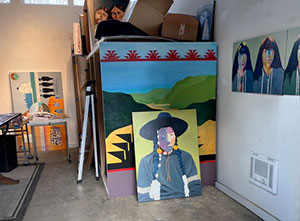
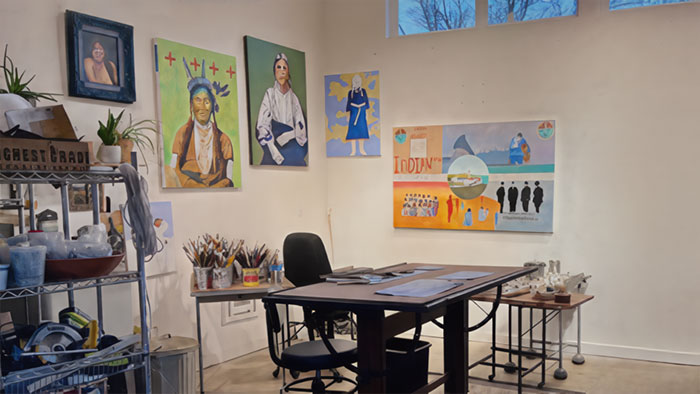
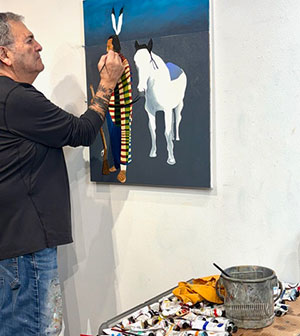
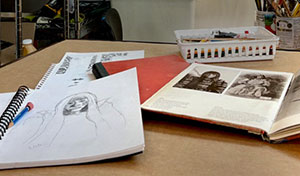
I paint in Portland, Oregon, in a studio I helped design. Soon after moving here twenty years ago I worked with an architect on a freestanding building across the patio from the house. Eight large windows face north. Since I retired from teaching seven years ago, I am in the studio almost every day. I begin mid-morning, break for lunch, and return for a few more hours. When I am particularly excited, or particularly frustrated, with a piece, I can be there before 8. The day ends the same way. Before the natural light fades, I photograph what I have done. In the evening I look them over and think about next steps. The paintings follow me into the house. I usually have several works going at once, each at a different stage. Stepping aside from one to focus on another is how I resolve what I am stuck on in composition and color. Each piece begins with sketches on paper. I choose a canvas size and sketch the central image. Background color comes next, and it often changes as the work develops. From there I build color and refine the faces and hands. I work in oil, which allows me to erase as I go. Painting is my way of preserving memories and turning them into something currently relevant. I was born and raised on the Hoopa Valley Reservation. Even as a child I drew the land and the river around me and the stories told to me by my elders. When my family moved off the reservation and I first attended the white man's school, the stories changed. It was some time before I understood the falsehoods contained in those textbook accounts of “manifest destiny” and the “taming of the west.” I became aware of and inspired by the growth of the Native American Rights movement. At the same time I was drawn to a set of stories that seemingly had no connection to my own, the ones told in the paintings of Van Gogh, Matisse, and Pollock. Later I discovered contemporary Native artists, among them Fritz Scholder, Jaune Quick-to-See Smith, and T.C. Cannon. Their books are on the shelves beside me while I work. For forty years I taught art at Chemawa Indian School, a boarding school whose students come from as many as sixty Native nations. My starting point is often a photograph. Images of Native people made between the 1860s and the 1920s by white men who believed they were documenting a vanishing race, and who often staged the scene, dressing their subjects in clothing and with artifacts they believed would appeal to a white audience. I recontextualize those images with layers of color, my own details, and references to contemporary Native lives. I aim to weave together the stories of Native lands and lives, the history others tell about our people, and the mystery I find in the work of artists who came before me. |
|||||
 |
|||||
| instagram: @hupapaint | |||||

|
|||||
|
|||||